Why We Are So Disconnected From Others—and How We Can Reconnect (Loneliness Part III)


Personally, I’ve found connection with others to be the hardest sphere of connection to develop. This is partially because it’s the sphere least within our control. It requires more than one entity, which adds a layer of complexity and nuance. Yet, it’s arguably the most important for a fulfilling life.
As humans, we’ve evolved the need to be intimately interwoven into a community. When we are unable to identify ourselves as a thread within a collective social yarn, we become quite lost. In present day, society and technology have evolved in a manner where we no longer require solid connection and community for our immediate survival. As a result, we’ve developed into a society that is more lonely, mentally ill, and at a loss of purpose than ever before.
In this article, my goal is to explore the underlying framework that might be causing such social disconnect: both at the individual and societal level. It’s split into 3 main sections, ordered to reflect the natural progression of building a social foundation from the ground up:
- Lack of Incentive discusses factors that are preventing us from seeking out connection, or engaging in socially conducive environments.
- Lack of Initiation discusses factors causing resistance towards initiating and engaging with others.
- Lack of Social Skill explores the necessary skills required to build and maintain deep connections.
This is followed by a list of actionable steps for each section.
Similar to the previous article in this series, each section is organized around specific roadblocks. Within each, I explore potential causes and solutions.
A quick outline is given below:
- Lack of incentive
- We’re being deceived by phantom connection
- Hyper-productivity culture
- Hyper-individualistic culture
- Most of us have unrealistic social expectations
- Niched intelligence
- Lack of initiation
- Social isolation
- Loss of 3rd space
- The damn phones… and Airpods
- Fear of rejection
- A need to redefine social success
- Lack of social skills
- We’ve lost the ability to hold space for each other
- We are unwilling to burden each other
- We don’t ask good enough questions
- We dance around honesty
- We don’t even know how to define friendship
- The skill of inviting, hosting, and introducing people is quite rare
- We struggle to prioritize the consistency necessary to build deep friendships
- Actionable Steps
Without further ado, let’s get into it.
Lack of Incentive
We’re being deceived by phantom connection
We’re being bombarded by algorithms and media developed by organizations interested in completely captivating our attention to drive revenue. Our devices, and the apps within them, are literally hijacking the millions of years worth of biological and psychological evolution embedded within our mammalian brains. Our technology is manipulating every component of our humanity, leaving us attached to our devices and the endless incentives within them:
- Emotional attachments to characters in movies, TV shows, and books
- Sexual arousal from pornography… or even some promiscuous/sexually-provocative influencers on social media… I don’t even want to think about where AI is going to take us in this realm
- Adrenaline highs from grandeur videos on social media, youtube, and Cinema/TV-Shows
- Emotional connection to the endless amounts of art on the internet: videography, music, poetry, blogs, photography… it’s practically endless.
Even though so much of the internet can induce all these hormones, feelings, and states of mind… we still feel extremely disconnected. And that’s because it’s all phantom connection in the first place. It’s only our thumbs, eyeballs, and ears. It only taps into a tiny portion of the human experience and our potential for connection. We need all of our 5 common senses, and those beyond, to fully connect on a proper human level with an experience, environment, or another being. We have to be engulfed in the medium of connection for there to be something real, or else it’s just a phantom template attempting to infiltrate our mammalian brain.
So, in-turn, we need to do a full 180, and practice fulfilling these human needs through experiences, activities, and people, that are physically tangible. We need to develop healthy emotional bonds with friends, family, and lovers through the real medium of life: eye to eye, ear to ear, hand to hand, heart to heart, rather than through the digital ether of the internet.
Hyper-productivity culture
The world of productivity gurus and “just grind” culture has also contributed to pulling us apart. We don’t just hangout as much as we used to. One reason for this is what I call the “productivity immune response”. Which is the habit of avoiding outings, situations, or activities that might inhibit our productivity. This productivity immune response isn’t all bad, I attribute much of my academic success to it, but when pushed to the extreme it decimates our social lives. This is because most of our time spent interacting with others isn’t considered inherently productive in the conventional sense. It takes us away from states of solitude, where we tend to have a greater capacity for focus and control over our time. This is further exacerbated by our current knowledge economy. Where in order to learn many technical things, we require long periods of solitude and intense focus.
Yet, even if we look at things strictly through the lens of productivity, rather than through a wholistic approach to life, I still believe hangouts and certain “nonproductive” activities greatly contribute to our overall productive output. When we make the time to hangout and connect, we appease parts of our connective psychology that leave us with a greater capacity for “productive” endeavours.
Here are some key points on the “productive” benefits of hangouts and socialization:
- We get to talk about different topics, challenges, and ideas. Hearing someone else's perspective or experience on how to overcome a challenge, or on how to develop an idea, can be of great benefit to us. Great conversations help shake up the snow-globe of ideas and thoughts inside of our minds. Which can lead us to greater creativity, discovery, and problem-solving.
- It helps to neutralize the social rumination and bad habits that stem from feelings of loneliness
- Diving down rabbit holes on how to make friends, date, or develop social skills
- Cuts out unproductive habits bred out of the attempt to fill the loneliness gap: doom scrolling & watching youtube videos or shows. Drug abuse & hyper-sexuality are a more intense version of this
- Chasing and obsessing over romantic prospects
- A high quality hangout, with great energy and conversation can be a big stress reliever. For example, I typically leave a great conversation fully energized for the rest of the day.
Hyper-individualistic culture
In the modern age, individualism tends to get over-glorified. As if having the Internet at our finger-tips is an excuse to think we can do everything ourselves. Figuring things out yourself is an important skill, but we also need to sacrifice a certain portion of our individuality in order to have the community necessary to fulfill our social needs. We are psychologically wired to depend on one another. Whether through the sharing of technical skill, emotional support, or just the presence of another human being. A truly healthy human is quite enmeshed into a collective. Some might consider this a burden, as you have to hold space for, and help out, other people. But the reward is a life of proper meaning. It’s a life filled with social responsibility, which in the end, amplifies our sense of purpose.
Most of us have unrealistic social expectations
This plays out in a variety of ways. We might have unrealistic expectations around friendship, or in the type of people we choose as friends: their emotional intelligence, skill, drive, health/fitness, or even financial success. These expectations prevent us from engaging or associating with specific people. Part of this filtration is us attempting to establish standards, by only surrounding ourselves with people who will complement our lifestyles and values. But, if we push this to the extreme, or over-conflate our state of development, it causes us to overlook fantastic opportunities for connection.
This phenomenon can occur on both ends. Sometimes it goes the other way. We feel as if the expectations of others are too high, that we can’t possibly meet them, so why the hell even try.
Many of us sabotage our social lives through both of the narratives above. The former through self-aggrandizing (or in healthier verbiage… “having standards”), and the latter through belittling our self-value.
The trickier part is, it takes two people to connect. So, if both people are being stifled by both narratives, we’re quadruply fucked… which is no good. We might not be able to completely reduce our quadruple fuckedness down to zero, but we can cut it in half by working on our side of the coin.
Starting with the first narrative: When we are looking for connection, we must learn how to neutralize any of our own perceived social superiority.
For example, you might be an excellent student, and feel intellectually superior (or hard-working) compared to some of your peers. In this case, you might look down upon connecting with those who aren’t so serious about school, or who struggle academically. I’ve guiltily done this in the past. I feared that befriending students with bad study habits would influence me into becoming a bad student. After maturing a bit, I’ve learnt that this is usually true, but that you can also control the amount of influence people have over you. And just because somebody doesn’t have their academic shit together, doesn’t mean they won’t be a good friend. This is where it’s important to understand your friendship values. Perhaps you meet someone in class who isn’t the best student, but is extremely emotionally intelligent. If this is one of your friendship values, which it is for me, then this could be an amazing friendship opportunity. Your strengths and weaknesses might just complement each other. Their emotional intelligence may help you develop yours, and your academic success or habits might rub off on them. The complementary benefits of certain relationships might surprise you.
For the second narrative: We need to learn how to remove others from social pedestals.
Most guys in their youth, me included, do this with pretty women. For some darn reason, we put them on a pedestal. To some extent, it makes sense. Reproductively, women are more valuable than men, so from the get-go, they hold more “biological value”. A man’s biological value tends to dramatically increase with age and development compared to that of most women… especially according to societal perceptions. Putting pretty women on pedestals is one of the biggest barriers to young men connecting with women. Instead of approaching the interaction from a level of neutral status, as equals, we tend to approach with a default inferiority. This applies to both the shy quiet guy and the overconfident rambunctious guy, both tend to be manifestations of feeling inferior to women. When in reality, if we just treated that pretty girl like another human being, and respectfully expressed our curiosity towards her, our connections with women would flourish.
Another good example is how people engage with their professional or academic superiors: such as bosses or professors. I see it in university all the time. Many students are petrified of speaking to their professors because they put them on a social/power pedestal. With the exception of a few assholes, most professors just want to help out students, and have honest conversations about the topics they’re interested in. Therefore, this fear is often unjustified.
In both cases, we have to train ourselves to remember that this is just another human. When we approach interactions with this mindset, knowing, and empathy, connection becomes exponentially easier.
Niched intelligence
Alain de Botton writes that “Loneliness is the price we pay for a certain complexity of mind”. This message encapsulates one of the definitions of loneliness discussed in the first part of this series, which was that loneliness partially stems from not feeling understood by anybody. And this is more likely to occur the more niche our interests and areas of intelligence become.
With the internet at our fingertips, niches have never been more accessible. You can practically learn about anything. You’d think this would enhance connection, which in certain cases it does, but allow me to explain through analogy the challenge that comes with it. Let’s say the start of the internet is the big bang, and the internet is the universe. Every new thing we can learn about on the internet is this universe expanding. With enough addition, and metaphorical expansion, the distance between these interests can become quite far. Therefore, in order for matter to condense in this universe, or for us as individuals to condense into connection, we might have to travel further through space and time to get to those with the same interests as us. In the process of niching interests, we’ve also nichified connection.
But this variable intelligence isn’t an appropriate excuse not to connect with people. We all have something we can connect over. After all, this expansion of knowledge also expands our potential to learn from each other.
Even if someone is the complete opposite to us, we can still connect with them through the core fundamentals of the human experience: pain and love.
Lack of Initiation
Social isolation
With the advent of the internet, work being confined to screens, and supercomputers being carried around in everyone’s pockets, we were practically doomed for some sort of social struggle. Then, as if that wasn't bad enough, a global pandemic hits, further incentivizing us to isolate from other human beings, and to live online.
Many of us have experienced social whiplash from eroded social skills following the pandemic. Even now, in 2026, many of us still have some social rust remaining.
So, what the hell do we do about this? Well, the straightforward answer is that we have to throw ourselves back out there. We have to regularly take social risks. We have to consistently put ourselves on the edge of our social comfort zone. One thing that Dr. K (a.k.a. GG Gamer on YouTube) says in one of his videos, is that we mostly just need to put ourselves out there, and our brains will do the rest. We’re wired for socialization, and if we simply put ourselves into the soup of conversation and presence of others, our brains will pickup on how to connect: similar to how we pickup verbal language. The problem nowadays is that we aren’t getting enough social immersion. We lack constant exposure because we’ve developed socially isolating lifestyles.
Here's how I try to increase my social immersion:
- I have at least one social event I go to every week
- Lately this has been a Thursday evening run club
- Additionally, I go to the same climbing gym 1-2 times a week
- I like going to coffee shops
- You can talk to the barista, you can talk to someone in line, or even someone you’re sitting next to. That’s 3 guaranteed possibilities for interaction… I like those odds.
- I try my best to break people, including myself, out of social autopilot
- Sometimes this means saying the thing I actually want to say… even if it’s weird. Most of the time the words that you say don’t matter as much as the intentions behind them. Words are confusing, they’re hard to interpret, we usually over-analyze them. When in reality, our brains are supercomputers for sensing people’s intentions. It usually doesn’t result in a rational analysis of their intentions, but rather a feeling: what one might call a gut feeling.
- This includes being willing to say the vulnerable thing first
- "As a rule, if you want a more fruitful social life… go there first: initiate first, joke first, be vulnerable first, plan first… etc."
- If I instinctually have the thought of wanting to interact with somebody, I try my best to dive in and interact with them before I overthink and ruminate myself out of initiating.
Loss of 3rd space
It’s not just our devices that are stripping us of the attention and awareness necessary for more fluid interactions, we also share less common space. This builds upon the previous point of social isolation.
We need spaces where we can just consistently mingle, share common interests, and be humans with each other. If you’re always stuck at home, whether rotting away on Instagram or working away on your computer, you’re secluded from any potential social interactions. The emphasis here is around a potential for interaction. You want to regularly go places where there’s a high probability of meeting people with common interests.
I suggest finding a location, or club, that’s conducive to connection, through one of the following means:
- Exercise & Outdooring
- My go to here is a run club & a climbing gym
- This could also be other clubs: swimming, biking, sailing, tennis, pickle ball
- If you don’t know where to start, and you don’t lean to any particular sport, I’d suggest joining an intramural sports team. I know plenty of people who do intramural volleyball or soccer, who seem to benefit alot from them socially.
- Specific hobbies/interests (beyond exercise)
- This could be meetups such as a philosophy club (i.e. a Socrates Cafe), a chess club, book club, writing club, entrepreneurial club, innovation get-together, etc… the list is endless
- This could also include your work/profession. You might position yourself into a career, or area of study, where you have colleagues that you can easily connect with.
- Random
- This could literally be anywhere. As I’ve already mentioned, one of my favourite “random” environments is going to specific coffee shops. But this could be restaurants, hookah lounges, pool halls… whatever fits your fancy.
Ideally, we can all find a minimum of 1-3 activities, groups, or environments to engage in on a weekly basis. This helps us reclaim the 3rd space that’s so essential for our social lives.
Here’s a little bonus that should be thrown in on occasion:
- Special events & trips
- Special events/trips are what I consider cheat codes for connection. They tend to shake people out of their normal routines, putting them into states that can be more conducive for connection. I always notice a shift in social states, in myself and others, when doing races, climbing trips, and backpacking trips. Longer and more difficult experiences tend to lower the activation energy necessary for connection.
- Another aspect to trips, particularly those in nature, is that it chucks many of our societal biases out of the window. In my experience, the societal perceptions of status between everyone in a group tends to be neutralized in nature. I hypothesize that being in nature reminds us of our shared humanity, and through such clarity, connection is bound to happen.
The damn phones… and AirPods
Nowadays, we’re so attached at the hip to the digital world, that we are literally closing ourselves off from those in our proximity. We stare at our phones while waiting in line. Or we put in earbuds on public transportation.
Vanessa Van Edwards, one of my favourite internet personalities, says “AirPods are killing connection”. Anytime we cover our ears, or direct our eyes towards a screen, we close off our awareness to the outside world. We deactivate any potential for initiating with others, and them initiating with us. Which means, we’re chronically fronting a barrier to social interactions.
We’ve got to get off our damn screens in public. Put the phone down when waiting in-line, and strike up a conversation with those next to you. Take your earbuds out on the bus, and interact with the person sitting beside you. Gift all the feel good chemicals of social interaction to yourself and others.
Fear of rejection
Many of us don’t start social interactions, for the same reason we don’t start many other pursuits, which is the fear of failing and being rejected by the world at large. But, we forget that failure in any pursuit is often accompanied by the underlying success of actually learning something. Besides, this fear is usually quite delusional. Most people you’ll interact with are quite kind. And you may be surprised to find how appreciative most people are when someone respectfully initiates with them.
A need to redefine social success
Mark Manson redefines the concept of “social success”, as whether or not you’re able to identify compatibility between yourself and others. He calls this “polarization”, which is the act of making yourself vulnerable enough around, or curious enough in, another person to test if you are compatible. He directs this philosophy more towards the dating world, but I believe it can be applied to all human interaction. The goal of socialization shouldn’t be to try and get everyone to accept or adore you. The goal of socialization should be to enjoy interactions with other human beings, and to identify those whom we are compatible enough with to build relationships. This may include surface level compatibility:
- Fun, enjoyment, laughter, and flirtation
Or a deeper compatibility with more substance:
- *Intellectual, emotional, sexual, or even situational (for platonic relationships I like to replace the sexual component with compatibility in playfulness)
When we redefine our definition of social success in this way, rejection serves a desired outcome. It’s a shortcut to knowing if we’re compatible with someone. That is to say, whether or not they are open to interacting or building a connection with us. That is the goal. The goal is to enjoy the company of others, and find people whom you are compatible with. Not to try and convince the people who feel “Meh” about you, into liking you. And it’s definitely not to seek validation or redemption from those who flat-out reject you.
We need to welcome rejection, as an essential aid in our social sifting process. It saves us much time and effort, in both our pursuits of platonic and romantic relationships.
*The components of deeper compatibility listed above come from Simon Sinek’s 3+1 rule of true compatibility. I highly recommend you listen to some of the episodes he’s done on the ‘Diary of a CEO Podcast’.
Lack of Social Skill
The right lifestyle serves as a fertile ground for connection. If we can develop the courage to initiate with others, this plants the seeds of connection within our fertile ground. But nothing will grow unless we develop the necessary social skills to nurture these connections. In this section, I’ll explore the social skills we may be lacking, but are necessary to grow beautiful connections.
We’ve lost the ability to hold space for each other
Good friends hold space for each other. We all need someone to accompany us through the inevitable hardships of life. Not to try and fix us, change us, or adopt responsibility over our struggles, but to just listen… and to attempt understanding our current state of being. This is what it means to hold space for someone. It entails gifting a medium where another human being can be encouraged to talk about, and discover, their own internal world. That’s what builds true connection, it’s when two people foster each other’s self-realizations and development.
Your capacity to do this is usually proportional to the depth to which you’ve explored yourself. Which should serve as further incentive to venture into oneself, as was explored in Part II of this article series.
So, learn how to hold space for people. It’s the foundation of deep connection. And if you have no clue where to start, first learn to hold space for yourself, then repurpose that skill into your connections with others.
We are unwilling to burden each other
Much of the time, we don’t want to burden others by asking them to partake in the trials and tribulations of our lives. Yet, counterintuitively, this “burdening” catalyzes strong social bonds. It’s you being vulnerable enough to ask for a helping hand. As long as you’re willing to share the same generosity, you’re inviting this person into a very fruitful and functional friendship.
Most of the friendships I see nowadays, between myself and others, are built strictly on convenience. We only do things with each other when we find the time. We don’t make the time. We don’t do things for others when it’s inconvenient, and we don’t ask them to do things that are inconvenient in return. The best friendships consist of a healthy dose of inconvenience and burdening. Our hyper-productive and independent culture has stripped away this essential component of friendship, and we need to reclaim it.
When someone you respect asks you for help, it truly feels like an honour. This simple act can build tremendous amounts of trust between two people. So take the lead, and within reason, ask others for a helping hand. It may surprise you how appreciative someone may be that you’re reaching out to them to fulfill this noble deed.
"We don’t build trust by offering help, we build trust by asking for it." - Simon Sinek
We don’t ask good enough questions
This past year, I’ve come to understand the power of asking good questions. Questions are the most effective tool for learning about the human in front of you. To connect deeply with others, we have to learn how to ask the right questions. This has multiple components. You want to ask questions that:
- Uncover their personal interests
- Get them talking about themselves
- Avoid yes or no questions, ask open-ended ones
- Formulate questions that appeal more to their feelings about facts rather than the facts themselves
- Explore topics where you can bridge the gap
- This means asking questions that are lead magnets for being able to say “me too”. It’s you setting up the situation for bonding through shared interests or experiences.
As was discussed before, in the “fear of rejection” section, one of my main goals in social interactions is to determine whether I’m socially compatible with someone. The quickest way of doing this is through the medium of conversation.
Therefore, if we can meticulously refine our questions to the person in front of us, it can allow us to, with great precision, uncover parts of someone’s character we otherwise would've never able to connect with. This is particularly powerful since most of us only form deep connections with those we’re forced to be around: fellow students, co-workers, team members, or family. Asking the right questions broadens our surface area for connection, sometimes allowing us to connect deeply with someone in just a single interaction.
We dance around honesty
Everybody dances around honesty, to some degree, depending on the social environment. The way I see it, there are two types of social honesty:
- Authentically expressing oneself
We will never know who has the capacity, and intention, to fully appreciate who we really are, unless we are able to show it. We tend to hide our true selves from others in very obscure ways. But, in order to invite others within viewing distance of who we truly are, we must find ways to appropriately peel back the layers of performance, low self-esteem, and overall avoidance towards vulnerability, that keep us out of sight.
- Authentically expressing how we feel towards others
Most of us could use more direct language in letting others know how we feel about them, especially if we like them. Vanessa Van Edwards talks about how bad we are at doing this. We have this fallacy around thinking we make our interest, liking, or appreciation towards others well-known. When in reality, they have no clue how we truly feel about them until we directly express our feelings. Often, the culprit here is a subtle aversion to certain levels of vulnerability. Even with those we deeply appreciate, we tend to struggle in directly expressing this appreciation. Which is unfortunate, because these small verbal acknowledgements drastically enhance the potency of our connections. Think back to a time when someone directly expressed their interest, admiration, or appreciation towards you. How did that make you feel? If done in a respectful manner, it probably made you feel pretty good, regardless of how close you were with that person. Now, imagine gifting this expression towards someone you’re getting to know, or whom you’re already close to. What effect would this have on your relationship? The answer in my life is that it almost always deepens my connections.
The former allows others to peer into what is within us, and provides them an opportunity to connect with us. Whereas the latter allows us to express what we’ve noticed within others, and to connect with them.
Each individual holds the potential to express social truthfulness in both directions. When two individuals meet, and have a capacity for both, they merge into this reciprocal pathway of connection with 4 degrees of freedom.
For those inclined to a physics analogy. It reminds me of the magnetic forces attracting two wires in proximity that contain current flowing in opposite directions.
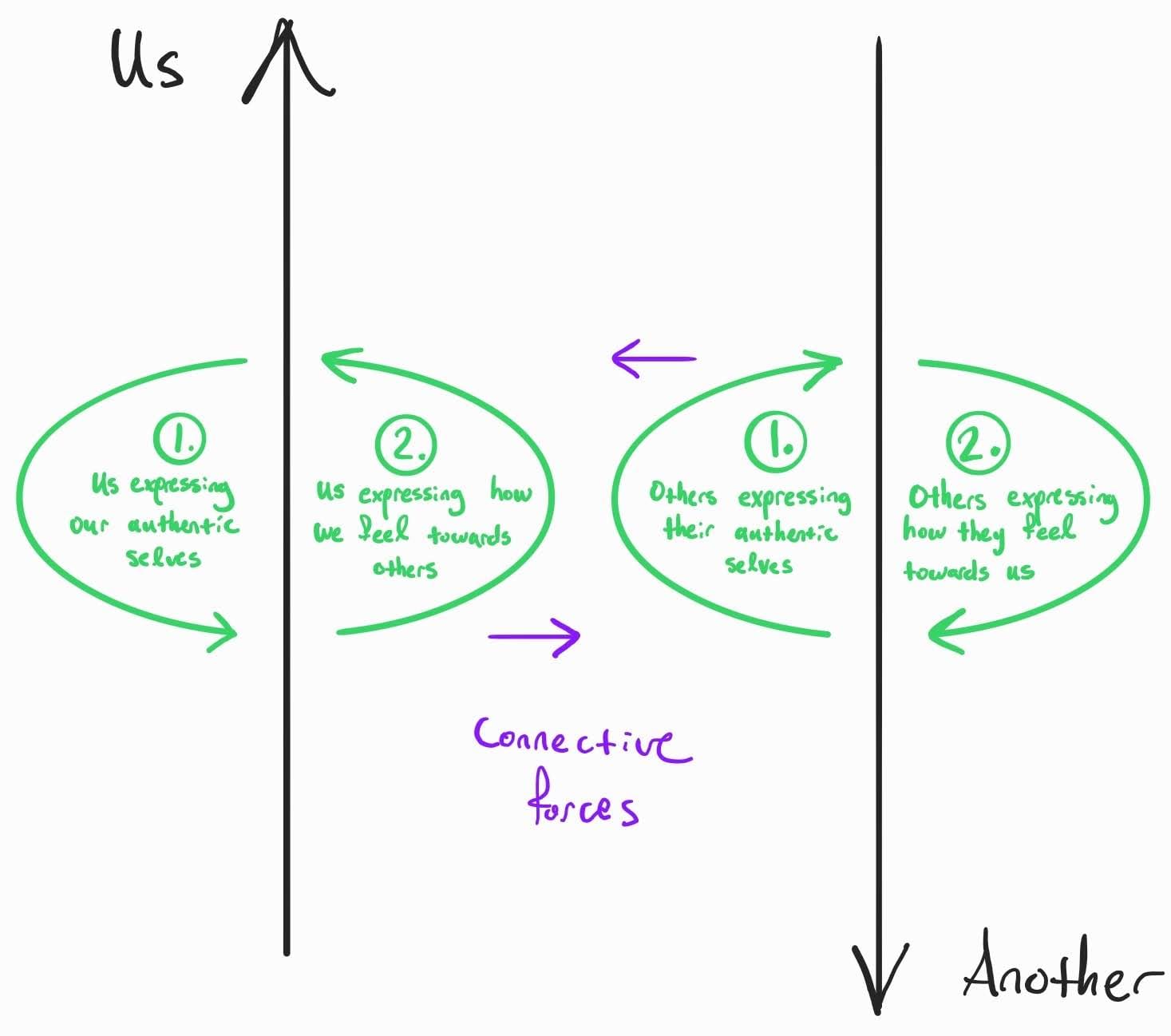
Where the direction of the black arrows represents current, or us and another passing by each other in real life. The magnitude of the current, which is proportional to the strength of magnetic attraction, could be defined as our capacity for authentically expressing ourselves. Then, naturally the magnetic fields (green lines) represent the cyclical nature of connection which can occur between the two directions of social honesty within the interaction. The magnitude of the magnetic attraction is thus proportional to the magnitude of the magnetic field, which is proportional to the magnitude of the current.
$$ F_s \propto \frac{I_{us} I_{other}}{d} $$
Where \(F_s\) is our magnetic/social attraction, \(I_{us}\) is the magnitude of our current of authenticity, \(I_{other}\) is the magnitude of the other person’s current of authenticity, and \(d\) would be the proximity between us and the other person according to our lifestyles.
"The extent to which we can connect with others is directly proportional to our ability to be vulnerable: to express ourselves honestly."
We don’t even know how to define friendship
I’m a firm believer that clearly defining goals dramatically improves our likelihood of achieving them. As social beings, most of us share the goal of having great friends. Yet, many of us struggle to clearly define friendship.
Is a friend someone you simply spend a lot of time with? It can be, but isn’t that just an acquaintance? Is it someone you enjoy spending time with? Possibly, but this still feels too broad; there are plenty of deep friendships developed through mutual suffering. Okay, so the bond we call friendship can be born out of mutual enjoyment or mutual suffering. There’s the word “mutual” that rings true here. A solid friendship seems to require a certain level of mutuality.
What mutual characteristics deepen friendship?
- Trust: believing someone won’t betray what’s in your best interest
- Shared interests: you have an intellectual or hobby compatibility. This means this person is someone you have more of an opportunity, or excuse, to spend time with. Time spent together is definitely another factor.
- Support: they encourage your growth. Whether a craft, sport, emotional intelligence, or spirituality. They antagonize the growth out of you.
Okay, thus far, here are the conglomeration of characteristics I’d use to define a solid friend:
- Enjoyment of their company
- You endure some sort of shared suffering
- Sometimes this simply means accompanying each other through the struggles of life.
- Enduring difficult physical, intellectual, or psychological feats together
- They are mutually appreciative of you
- They are trustworthy
- They share common interests with you
- You spend a minimum amount of time with them
- They support your growth
- They are dependable
The skill of inviting, hosting, and introducing people is quite rare
If you feel like you never get invited to things, it might be because you haven’t thrown yourself into the loop of social initiative that surrounds you. The more you invite other people to do things, the more likely they’ll do the same. Of course, this depends on the type of people you’re inviting. Some people are followers. They only get out to do things when others offer. They simply want to be told a time and place. And that’s fine, I have people in my life that are this way and I still enjoy their company. But, I also want to befriend initiators and planners so that I’m not the only one trying to curate hangouts, activities, or trips.
The more you invite people to do things, the better you’ll get at identifying social leaders vs. followers. With this understanding, you can begin balancing how much to invest in both friendship types, saving you from being the sole initiator.
Inviting is just the beginning of this process. Then, one needs to learn how to plan and host. Hosting consists of learning how to make people comfortable in a space. It means cultivating an environment that is socially conducive for an individual or group. I’ve learnt tons about hosting from my dad and brother. They’re both great at getting big groups together on weekends, or for special events, to hangout and eat great food. Here’s what I’ve learned from them:
- Being able to cook great food is one of the greatest social assets. Breaking bread with people is a subtle yet potent connector.
- Learn how to invite the right combination of people. I’m still working on this one. I tend to have friends that span all age groups, hobbies, and professions. But here are some fail-safe characteristics of people that are easy to bring together, those who are:
- Courteous
- Pleasant to be around
- Appreciative of the invitation
We struggle to prioritize the consistency necessary to build deep friendships
Building deep friendships requires a fair bit of time. There’s no getting around this. Our perceived depth of connection with someone is usually proportional to the amount of time we’ve spent with them. So, if we want to build deeper friendships, we need to prioritize making time for our friends.
Recently, I’ve come across the idea of “dating your friends”. Now, this isn’t a polyamorous suggestion, rather it’s an invitation to bring the same level of intention to friendships as you would to romantic relationships. Some of us will go out of our way to make a date happen with someone we barely even know. Yet, we are flaky and elusive when planning things with our “close” friends.
"Invest in friendships with the same amount of intention as romantic relationships"
But what does this actually entail?
It means engaging in upkeep. Upkeep means not going more than 1-2 weeks without reaching out to, or spending time with, those inner circle friends. When life puts us in a whirl, it can be hard to prioritize friendship. Some weeks you may only have time to send a goofy or thoughtful text: and that’s okay. The goal here is to let the other person know they’re on your mind.
I’ve dabbled with a friendship calendar, where I recorded when I called or hungout with specific people or groups. This allowed me to visualize my social engagement patterns: how I was spreading my energy & attention across my friends, and who I needed to engage in upkeep with. After a month of doing this, I realized that I tend to strategically space out and cycle through my friends. I’d hangout with 1-2 friends each week, but then not see each of them for another 3 weeks to couple of months. This made me realize that I was socially spreading myself thin. Nowadays, I’m trying to be more intentional about consistently engaging with a few key people who I want to develop deeper friendships with.
Actionable Steps
Lifestyle Shifts
- Instead of searching for feel-good hormones through your devices, get them from humans IRL. Reach out to friends instead of scrolling. Go to coffee shops, gyms, or some third space where you can share little interactions or conversations with those around you.
- Occasionally just hangout with people, without a goal in mind. The point is to simply spend time with other human beings. I like aiming for one planned hangout a week (outside of recurring clubs or activities).
- Volunteer some of your time. Either in your community, in research, or amongst friends & family. Often, this entails patiently listening to someone who needs to vent about something.
- Visually imagine taking yourself and others off of any social pedestals. Neutralize perceived differences in status, then interact from a level of equality.
- Try your best to connect with people over your shared humanity. This is especially important to do with those of different beliefs or circumstances to you. There is so much to learn from people, and when this doesn’t seem true, remind yourself that even a small insight into how others think can sharpen the accuracy of how you see the world.
Taking Initiative
- Have 1-2 recurring social events every week. Whether it’s a club, sports team, or group workout
- Run clubs have recently been my go-to. I’d like to eventually add in yoga or breathwork classes
- Take off your damn headphones in public, and get off your phone. Be open and welcoming in your body language.
- If you have the instinct to interact with someone, jump in before fear or overthinking paralyzes you. It’s the race to initiative… win that race.
- Be the person to go there first. Initiate first, joke first, be vulnerable first, etc.
- See rejection as an opportunity to learn. It means you need to work on yourself and/or the other person’s not ready/compatible. Appreciate rejection as much as social acceptance: use it as a sifting tool to find your compatible humans.
Developing Social Skills
- Become a damn good listener. This means attempting to understand the state of the human being in front of you, without trying to change anything. Holding space for someone entails freeing space for them in the mold of your presence.
- In conjunction, work on holding space for yourself. In short, develop your emotional intelligence. A wonderful resource I recommend for this is The School of Life.
- Ask others for help whenever you need it: a drive to the airport, help moving furniture, a simple conversation when you’re struggling with a relationship… etc. Asking for help builds trust, and deepens relationships.
- Refine your question asking abilities. Practice translating your curiosity towards someone into verbal language. It may help to prime yourself by looking through great question cards, such as those by The School of Life.
- I’m particularly fond of their “Meeting Friends” and “Dating” sets
- Practice social honesty: outwardly show your authentic self, and directly express your feelings towards others (especially the positive ones).
- Here are some examples of this on the platonic end:
- “I appreciate how much you support me”
- In the case of anybody that has supported you, or that continues to support you
- “I admire your outlook on, and way of, life”
- “I really enjoy my time with you, we always have such interesting conversations”
- “I appreciate how much you support me”
- and examples for the romantic end:
- “Hi, I’m … , you piqued my curiosity from across the room so I wanted to come say hello”
- “I find you quite interesting, and attractive, and I’d love to get to know you better”
- The last two above are mainly for the earlier stages of romance… which is where we tend to struggle the most with showing or expressing our authentic selves. They also work for platonic pursuits, but may be perceived as a bit intense.
- Here are some examples of this on the platonic end:
- Write out your friendship values. Then develop your capacity to embody those values. Eventually, you will attract those who have done the same.
- Invite someone, or a group, to share a dinner with you this month. Build up a practice of consistently inviting people, and eventually increase the frequency. You’ll become a gold-star host in no time.
- Engage in upkeep with your friends. Perhaps start a friendship calendar, and record when you last interacted with friends you want to become closer with. Prioritize monitoring when too much time has passed, and consciously make an effort to reach out. Even a small goofy text does the trick.
Alrighty, that wraps up my exploration of why we might be so socially disconnected, and what we can do to potentially amend a life deprived of social connection. I want to end on a note of encouragement, because it’s not easy being a social creature. Although evolutionarily advantageous, and quite beautiful, the social framework of our psychology sneakily introduces a painful undertone of chronic rumination. Luckily, there are skills, philosophies, and practices which can help us manage this cognitive burden, and exalt it into something that aids us in our search for connection. Hopefully, this article has exposed you to some of these tools, or has inspired you to find some of your own.
I hope you enjoyed the read. If there’s anything you particularly resonated with, or think is missing, please comment it down below. I’m always curious to hear your thoughts :)
Commenting requires you to subscribe to this website. It’s free, so don’t be shy. Subscribers also receive occasional newsletters, containing some ideas I’ve been pondering, or habits and resources I’ve found useful. If you prefer not getting emails, you can click “unsubscribe” in your email inbox.