Lessons from a Peruvian Adventure

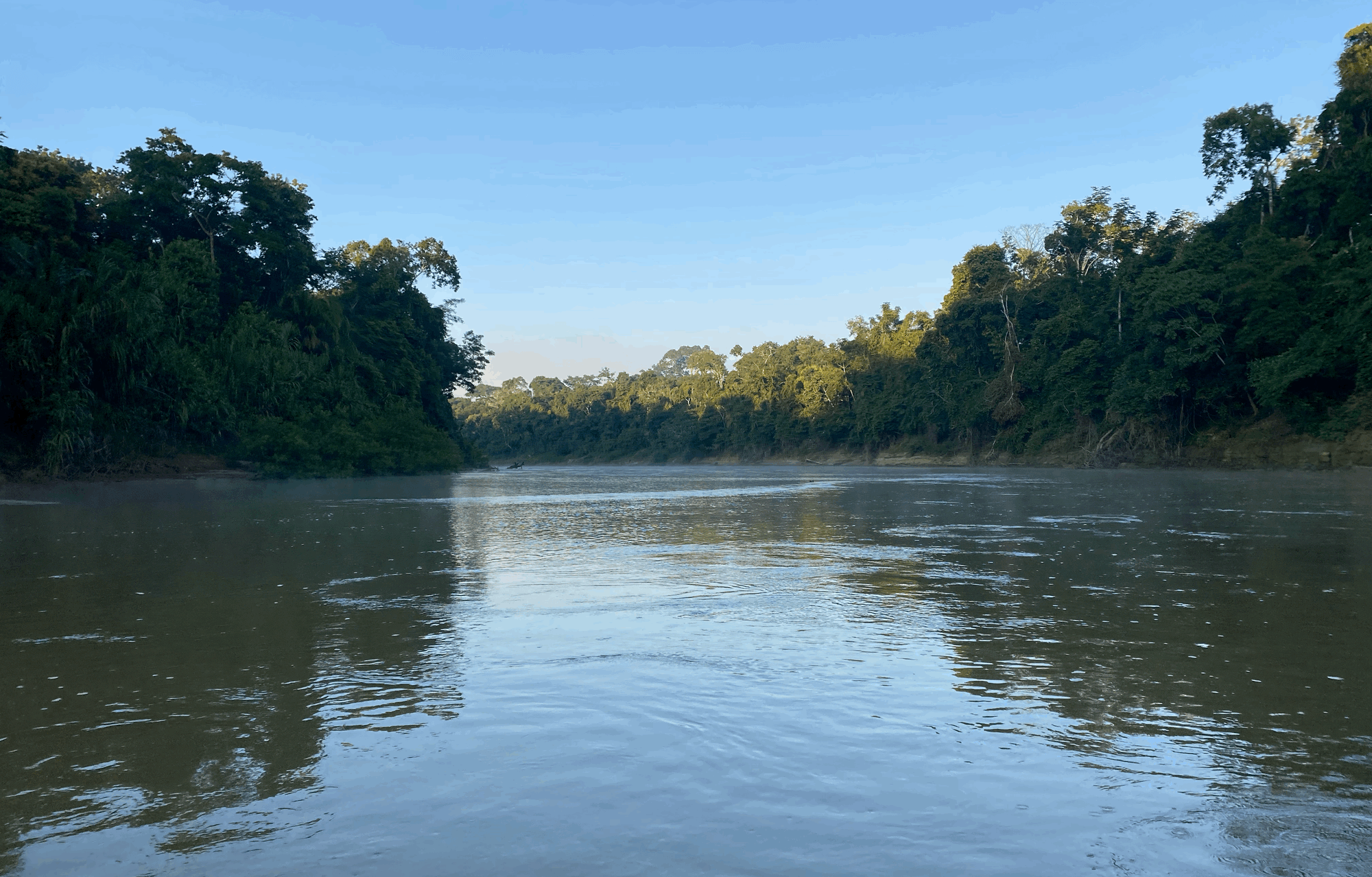
I recently got back from a backpacking trip to Peru that gave me a variety of new insights into life. There’s an unfathomable amount of variety and diversity in Peru, from vast environmental biomes to a broad socioeconomic spectrum. I got to experience just a little bit of what this beautiful country has to offer, and in doing so, it taught me many things about myself and the world. Below I will share with you a brief summary of the lessons I learned from my Peruvian adventure.
I learned that:
People truly make or break an environment
No matter where I was, whether in the heart of the jungle or at the top of a mountain, the quality of my experience really came down to the quality of people around me. Whether we like it or not, we are highly influenciable beings. It’s how we learn, it’s how we adapt, it’s how we survive. Therefore, the quality of those who influence us, affect the quality of our own experiences, mood, and thoughts. The people around us are everything.
Me and my girlfriend spent time volunteering in the beautiful mountains of the Colca Canyon. Even though it's an amazing place, with plenty of food and lodging, our experience suffered because we lacked community in the area. Whereas, we had a much more uncomfortable and difficult volunteering experience in the Jungle of Ucayali, but it was more enjoyable because of the people. We had a little volunteering community with camaraderie, good conversations, and loads of laughter. That’s what made all the difference.
Constant movement elevates your baseline mood
Rarely on this trip was I stuck indoors. Rarely on this trip did I feel disassociated or trapped. Yet when I got home and I continued with my normal routine, these two feelings popped up almost immediately. In modern cities we confine ourselves to our houses, or the bounds of a building, for most of the day. This isn’t the norm in Peru, and it felt liberating. In some places you are never “inside”. Your cabins in the jungle have open walls and doors. You are always connected to the smells, sounds, and environment around you. You become the environment, as if a natural purpose has been endowed upon you. It’s something foreign to many of us in the modern age, yet something indigenous cultures have known for millenniums.
Being outside of the house, or simply “outside” forces you to move. It’s a state of movement, and that’s one of the things I loved most about my trip. Even-though I’d been sick, sore, and exhausted I was able to liberate my body through constant movement. Because of this my mind had a tendency of being clearer, my sleep deeper, and my overall state of mind elevated.
Happiness and fulfillment aren’t directly connected to productivity
Before my trip, I was constantly trying to achieve a productivity equilibrium. I would attempt at maintaining a daily productivity level. This included lots of planning, time-blocking, debating task prioritization, and not knowing how to relax. I’d developed the notion that happiness and fulfillment were reliant on my productivity. On my trip, I was ripped out of this bubble of structure and control. My life became reliant on airlines, weather, volunteering, and even how or where to make my food. Even though I spent most of my time experiencing things rather than “productively” completing tasks, I was still able to find contentment and fulfilment. Planning became a perhaps, instead of a must. With that, I got rid of this notion that my happiness/fulfillment was reliant on my productivity. Happiness and fulfillment come from doing things that are worthwhile and finding peace, not from stressing about checking everything off your to-do list. The internet and modern culture have swayed us to productivity extremes, but I believe that traveling outside of your bubble, can recalibrate your productivity urges and anxiety back down to a healthy level.
Backpacking recalibrates your discomfort level
Before this trip, I had certain comfort limitations I'd developed out of habit. I could only fall asleep in a certain position at a cool temperature. I would never poop in public restrooms. I’d shower twice a day. Even walking places was a foreign concept to me. Then suddenly, I went to sleeping under a mosquito net and pooping onto leaves in the jungle, showering every 2-3 days, and walking everywhere. Things were switched up a bit. I was forced to be tolerant towards uncontrollable discomforts in my environment. Modern city life made me a pathetic human being, but this changed after all the sand fly bites, the heavy labor, the exhaustion, the sickness, the sometimes bland food, and just the unpredictability of it all. Comfort has a different meaning when its juxtaposed with discomfort. Comfort loses its value unless recalibrated by discomfort. That’s one of the gifts of backpacking.
There is deep knowledge & technology we have lost
Among some of the most amazing natural biomes in Peru, it also has an extraordinary diversity of food and ruins from past civilizations. From the Inca trail and Machu Picchu to the Nazca markings, Peru is abnormally littered in remnants of a sophisticated past. I had the honor of hiking the classic 4 day Inca trail into Machu Picchu. The trail itself is an amazing endeavour, carved into the sides of the mountains, over mountain passes, and sometimes through the mountain itself. Along the path are a variety of ruins, spanning from giant flower shapes embedded with terraces, living areas, and ceremonial sites, to astronomical sanctuaries perfectly placed to observe the night sky. These structures are feats of engineering that even today would be incredibly difficult to construct in these locations. The foundations of Machu Picchu itself is made of perfectly symmetric white grannet blocks that were melted together, which is deemed impossible by todays industrial experts. There was something going on with the ancient civilizations of peru, most notably the Incans, that we do not understand today. There are over 4,000 varieties of potato, around 50 varieties of corn and chilli still grown, and so many others that they bred at different altitudes. When you see this diversity, the giant terraces etched into the mountainside, when you hear of the complexity and progressiveness of these societies, you can’t help but wonder the knowledge we’ve lost. What beauty, strength, and wisdom did the humans before us have? All this knowledge developed over thousands of years just to be etched away by the Spanish. It’s pretty astonishing, sad, and reflective of our own ignorance.
Another baffling thing about Peru is how poor most it’s people are, for a country drowning in resources. From an ungodly diversity of produce, minerals, oil & gas, and culture, it should be one of the most prosperous nations in South America: if not the world. First colonization, and then the influences of capitalism seem to have sucked this country and its people of great potential. Its commercial products are monopolized, special interests from other countries incentivize corrupt politics, and the burning of the Amazon. This place needs it’s power back, the wisdom of its ancestors, and a transformative philosophy on how to make a living. The Amazon is where these truths hit hard. You see pristine ecosystems clear cut and replaced by cattle grazing, banana and palm plantations, or nothing. Peru is scarred with remnants of ancient trees and ghosts of the most beautiful biological network on earth. And yet, after all this taking, the people living there are still dirt poor. Their culture, wisdom, livelihood, and happiness, all burned away from them.
One thing I realized on a 3 hour minivan ride through the Ucayali region of peru, was that biomimicry might be the only thing that can save the jungle and its people. As I passed thousands of acres filled with banana & palm plantations I could only imagine the giant hardwoods and dense greenery that once existed there. Now, because of the economic climate, the people have no other option but to ravage the sacred forest around them. But what could it look like? Could this place be supported by interconnected communities using clay and living tree highways inspired by termite networks? Could profits be driven by seasonal harvesting and farming within the forest itself? Imagine an agroforestry economy driven by brazil nuts, figs, yuca, citrus, medicines and sooooo much more. It could become a knowledge hub of bio-inspired living and design. Its community could teach the world, and in today’s digital economy it could bring them the profit needed to revitalize the amazon: aka the lungs of earth. Furthermore, this could be supported by carbon credits allocated by modern industry and 1st world nations for reforestation or conservation. But for now, the amazon is in danger from gold mining, logging, and ignorance. It’s people suffering of poverty and hopelessness, while a select few, very far away in privileged nations, make profit. Robbing the earth and a human future of the prosperity it deserves. Even though it's a mountainous task to overcome, and will likely take centuries, I believe it to be possible. And I hope it comes before it's too late.
The end
I hope you found some of this interesting. If you have any questions, comments, or bits of criticism, comment them down below. I’d love to hear it.