In praise of the early morning: Why and how you should wake up early


Imagine this, you’ve just gotten out of bed, walked downstairs in the dark, and poured yourself a cold glass of water with a bit of lemon juice. As you sip, you silently gaze into the soft flames of sunrise.
Alternatively, imagine you wake up and light is already beaming into your room. You get out of bed sweating, trying to adjust to the brightness as you walk downstairs. As you pour yourself a glass of water, a family member or partner is already asking you questions and telling you about their day. You look at the kitchen clock: “10:00 AM”, and sigh at the loss of morning.
The first scenario is my ideal. There is something about getting up early before everyone else, and sitting in the stillness of morning. It feels like I’m in sync with the sun and nature, as if we’re waking up together. On the contrary, the second scenario, which is an exact description of how I woke up this morning, is not so ideal. I’m waking up into the business of someone else’s day, into the heat of the sun, and the buzz of nature (or humanity if you live in a city). I feel behind, stripped of peace and a solid start to my day. I’m suddenly more likely to skip parts of my morning routine, essential to grounding my mind & body. But that first scenario, that early morning, the freshness, the peace, that fills me with calm energy. It allows me to start my day on a balanced footing, rather than stumbling into the chaos.
Table of Contents
- Why I Love Mornings
- Early Morning Challenges
- Inconsistent sleep schedule
- Socialization & staying up late
- Sleep to wake inertia
- The morning & evening routine
- The damn phone
- Eating too late the night before, or too early in the morning
- The Power of Mastering Your Morning
Why I Love Mornings
Mornings are incredibly powerful in my life. They’re when I have the greatest capacity for deep thinking and tackling high-resistance tasks. Early mornings, in particular, are productivity gold. During the school year, I’m often surprised how much of a lab report I can get through in a 1-2 hour early morning session, compared to an afternoon study session. It can be 4 times as productive, especially with regards to overcoming writer’s block. For me, early mornings are practically a no-brainer, but the challenge is getting there consistently in the first place.
Early Morning Challenges
There are a variety of habits and factors that sabotage early mornings, some are more obvious than others. The biggest and most obvious challenge is sleep hygiene. Below I’ve listed some challenges I consistently run into, and how I’m trying to overcome them.
Challenge #1
Inconsistent sleep schedule
We all know it, and most of us ignore it. The truth is, most of us need a minimum of 8-9 hours of sleep. The kicker is getting that 8-9 hours in a consistent time window. As many sleep scientists and health experts, such as Dr. Matthew Walker, have been adamant about in the recent years, our sleep is regulated by our circadian rhythm, which needs consistency to function properly. This means that when we wake up at 6:00/7:00 AM on weekdays, and then at 9:00/10:00 AM on weekends it screws up our circadian rhythm (hence our sleep as well). We also know that sleep consistency (i.e. consistent bedtimes & waking times), allow us to enter deeper and longer periods of NREM & REM sleep.
Yet, many of us fail to befriend our circadian rhythm. We abuse it with abnormally late nights, and then expect it to smoothly respond to early mornings. Or, we suddenly switch to an early bedtime, and proceed to get frustrated when we can’t fall asleep 2 hours earlier than usual. Personally, I’ve adopted a variety of habits that help me fall asleep and wake up at my preferred time:
- Consistent sleep/wake time habit
- Eating dinner ~2.5-3 hours before bedtime (More on this in Challenge #6)
- Decrease screen-time usage in 2 hour window before bed
- I have some special warm/extra-dim filters I have built into my tablet & phone that I turn on at night.
- No social-media or Youtube in this window
- Shortcutting rumination
- Via journalling
- Long night walk
- If I’m really struggling to stop my mind, I’ll throw in a couple rounds of Wim Hof breathing before bed.
- Stretching and rolling before bed
- Breathwork & meditation
- Wim Hof breathing
- 10-20 minutes of Yoga Nidra (NSDR)
- Acceptable amounts of cardio throughout the day
- Specifically running, biking, and/or swimming
- I find this really helps me fall asleep
Challenge #2
Socialization & staying up late
This is another tricky one. We tend to be more lenient with our bedtime when hanging out with others. I’ve found this to be particularly challenging. Trying to balance your bedtime and some semblance of a social life can feel like an impossible compromise. Spending time with others often feels like a justifiable reason to delay bedtime, especially since socialization puts us in a state of flow, making time slip by faster than we realize. This happens to me all the time, especially for social activities occurring later in the day.
I’m still trying to figure this one out. But here are some things I’m trying to do more
- 1 freebee late-night/week rule
- Befriend some early birds
- Be disciplined enough to leave the hangout early (set an alarm)
- Schedule hangouts earlier in the day
- Perhaps schedule more activities in the morning or early afternoon
Challenge #3
Sleep to wake inertia
The ability to actually get out of bed early is the true make-or-break of early mornings. This can be the most difficult component when you’re trying to wake up earlier than usual. If you’re already used to crashing out at 9:00/10:00 PM and waking up at 5:30/6:00 AM, it’s definitely a lot easier. If this isn’t the case, or you have trouble sleeping, getting out of bed can be a pure act of will. Here are some tips to get you onto your feet more quickly after waking.
- Establish a consistent sleep/wake schedule
- Wake up to light
- Sunrise light or Casper light
- Set-up an auto curtain that opens before your preferred waking time (or leave your curtains slightly open)
- Scheduling things earlier (gives you a sense of urgency)
- For example: a physiotherapy appointment, a meeting with a friend, and going to early morning events such as running or exercise clubs
- You can even schedule an early block of time with yourself, with the intent of completing a specific task (writing an article or lab report, doing your taxes, going for a long bike ride, etc.)
Challenge #4
The morning & evening routine
Both night & morning routines feed into each other. I believe it’s essential to have clear, discretely written out routines. Here’s a direct screenshot of my current ideal morning routine:
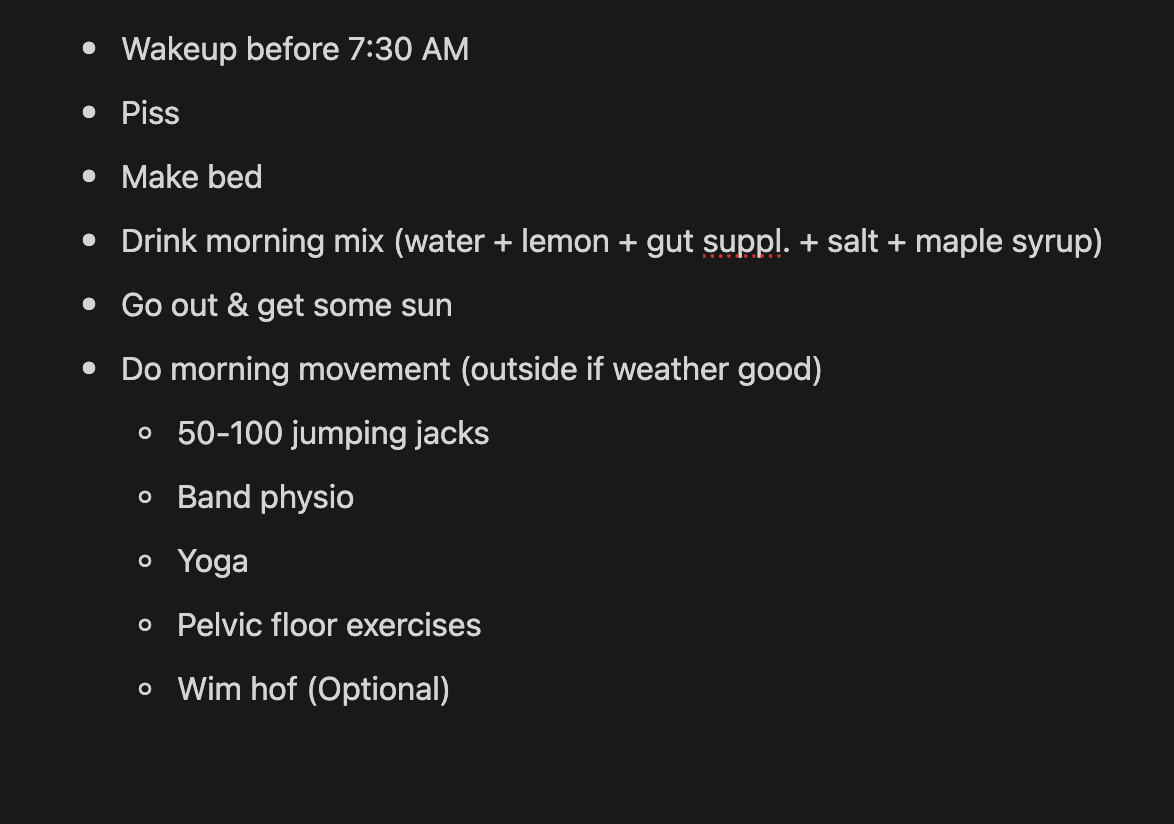
I try my best to fit it into a 1 hour window so I can quickly start my day. It consists of some hydration, and some movement ideally done outside. Sunlight early in the day has been shown to increase cortisol levels, and decrease adenosine, both of which are essential for wakefulness. Adding in early morning exercise helps to further increase morning cortisol levels associated with wakefulness. Finally, it’s not included above, but I wait 90-120 minutes before drinking my coffee, as suggested by Andrew Huberman. So an extension of above would be:
- ~7:30 AM → Morning Routine
- 8:30 AM → Start deep work/study
- 9:00 AM → Get coffee then return to work
Some days the morning routine can be hard to get through, but staying true to the bedtime routine is where I struggle. The trick with bedtime routines is that you need to factor in your entire afternoon & evening: when you’re going to exercise, when to cook and eat, how late to socialize, and when to start prepping for bed. Then, when life inevitably throws things your way, you have to figure out how to re-organize this routine for each individual evening.
I’ve found it helpful to draw out my ideal evening routine/schedule so I can more easily conceptualize the optimal time windows for me to exercise, eat, prep for bed, and fall asleep. Here’s a little sketch I created recently using a template from Cal Newport’s Time-Block Planner.
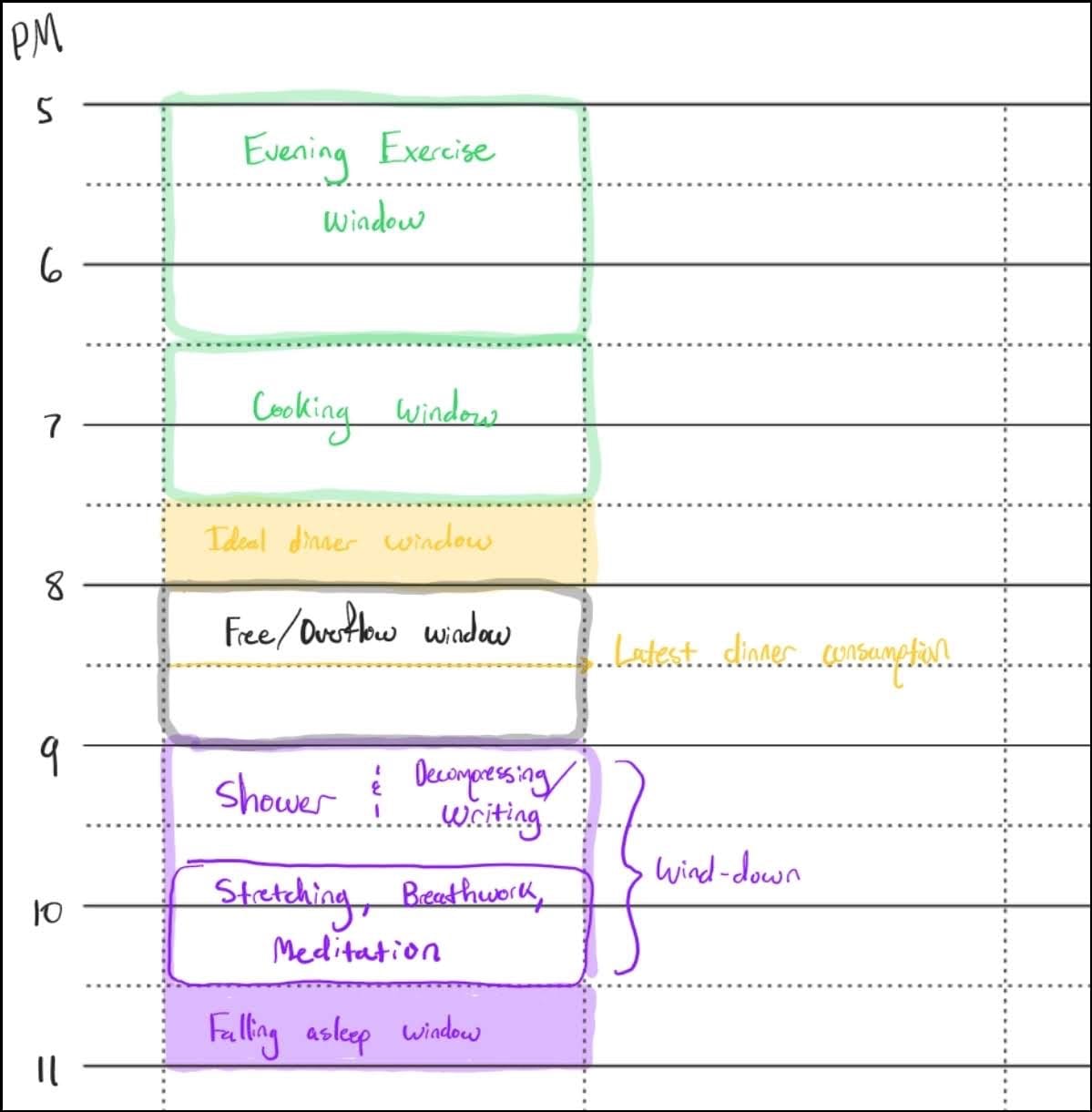
Of course, it’s impossible to conform to these time windows every single day. But this is a default template that allows me to more easily move things around, so that I can get to bed around the same time. Sometimes that means an earlier exercise or cooking window, sometimes a hangout cuts into the wind-down window and vice versa. The whole point is to have a default system, or sequence of events, that you consistently execute before bed.
Challenge #5
The damn phone
First off, I have a rule when it comes to my phone, it’s not allowed upstairs. For me, upstairs is where my bedroom and office are. I keep my phone on the first floor, on a little table nook under a lamp. That’s its resting place… nowhere near my resting place. My second rule is that I can’t look at my phone until I finish my morning routine, which normally consists of my first hour of waking. Additionally, my only two dumb dumb apps (aka apps I get stuck scrolling on: Instagram & Youtube), are off limits until I get minimum 2-3 hours of productive work done. I typically just limit my use of them to the afternoons. I’ve started using ScreenZen, which is a great app for adding some resistance and time limits to certain apps. For example,
for my phone I have
- Instagram limited to 3 windows of 7 minutes
- Youtube limited to 2 windows of 10 minutes
for my laptop I have
- Instagram available for 5 minute windows (no limits because I don’t get stuck on my laptop)
- Youtube limited to 1 window of 20 minutes (I permit more when researching topics)
for my tablet I have
- Instagram off limits
- Youtube off limits
I also have most app notifications turned off except for some essentials, such as iMessage/WhatsApp, my banking app, and my calendar apps. I don’t even have email notifications turned on. Of course, I’m human, and I’m a Gen-Z’er, so I do often cave and break my rules. It’s always a stupid decision, and I always regret it. But this is a standard I’ve set for myself, which makes me more likely to oblige, and it helps protect my mornings & evenings from chronic distractions or doom scrolling.
Challenge #6
Eating too late the night before, or too early in the morning
I find it necessary to leave 2.5-3 hours between eating a large dinner and going to bed. If not, I can’t decrease my body temperature and heart-rate enough before bed. Both of which are essential for falling asleep. Eating earlier also tends to buffer in more downtime before bed by incentivizing you to get things done sooner. Additionally, if I feel like munching on something in this window, I’ll either eat a bit of low-sugar homemade jello or drink some tea sweetened with honey.
I prefer not eating in the early morning. My peak focus state consists of coffee, or some other brain enhancer, while fasted. I find that as soon as I eat, some focus is lost. Additionally, when I have my first bite to eat in the morning it’s not satiating. A small amount of food tends to make me even hungrier. I’ll sometimes go downstairs in the middle of my morning for a bowl of granola, then I’ll finish that bowl and start rummaging through the fridge. Next thing you know I’m spreading almond butter on rice cakes and cutting up a banana. This food distraction tends to spiral into a phone distraction or into my family members asking me to do things. Next thing I know, my attempt at quickly eating a bowl of granola, turns into a 1.5 hour derailed portion of my morning. Therefore, I prefer to do my morning deep work fasted. Afterwards, I’ll break my fast with a proper meal. This decreases the likelihood that I get distracted, and it incentivizes my first meal to consist of whole foods, rather than an amalgamation of snacks.
The Power of Mastering your Morning
I feel like a slightly different person in the early morning. I’m more cheery eyed and excited for the day ahead. It’s as if the hue of morning infuses a positive tint onto the day ahead.
Completing tasks that normally feel like moving through molasses, become almost effortless. These hours of quiet and stillness tend to liberate some headspace. Allowing me to accomplish deeper, more focused work, while in a more enjoyable state.
Overall, any day that starts with an intentional early morning makes me feel exponentially better about myself. I feel like I made the best of a day. I feel like someone who gets stuff done, someone who is working towards something. I feel ahead of the day and therefore weirdly ahead of life. I have the clarity to see where I’m going, and how to get there. Additionally, I don’t get as frustrated when plans change later in the day, or when my day inevitably gets interrupted, because I’ve already done my essential tasks. Early mornings are a form of time & energy insurance. With the right routine, they guarantee you 2-3 hours of deep work, rather than gambling with your productivity throughout the day. This is why you should cherish and protect your mornings. This is a duty I’m trying to take more seriously, for guarding these sacred hours of the morning is what offers me the greatest opportunity to get things done, and fulfill my potential.
So I challenge you to ask yourself:
- What would my life look like if I consistently woke up “early” (whatever this means to you), for a month or a year, and worked on my most important tasks, projects, or hobbies?
and
- What challenges are preventing me from achieving this? How can I overcome them?
You probably have some solid, appealing answers to these questions. But the real question is, whether or not you’re willing to take on the responsibility of actualizing them into your life. It requires a lot of discomfort, and discipline… but the result is pricelessly fulfilling.
Just quickly, I want to address the people whose natural circadian rhythm makes them lean more towards late nights than early mornings. The people in this group tend to be particularly prone to insomnia, and poor sleep hygiene, so I’d say the tactics above are even more applicable for this group. You don’t have to be waking up at 5:00 AM, but it probably wouldn’t hurt to consistently wakeup within the earlier time boundaries of your circadian clock.
Below I’ve linked a couple articles from The School of Life that beautifully encapsulate the power of early mornings and going to bed early:




As always, I hope you enjoyed this article. If you so dare, drop a comment down below on what you’re trying to implement more into your morning or bedtime routines. I’m always curious to hear what habits people are trying to work on. Now, be nice to your body tonight, and grace yourself with an appropriate wind-down routine/bedtime.
Commenting requires you to subscribe to this webpage. It’s free, so don’t be shy. Subscribers also receive biweekly (every-other week) newsletters, containing some ideas I’ve been pondering, or particular resources I’ve been liking. If you prefer not getting emails, you can click “unsubscribe” in your email inbox.